Business-Ready AI: The Missing Layer Between “Great Models” and Real Value

Most AI failures aren’t technical.
They fail because the organisation never made AI a business system — with owners, ROI, adoption, trust, and risk controls.
You don’t need “more models.”
You need to become Business-Ready.
Context & Problem Statement
In many organisations, AI starts the same way:
– A team builds a model that looks impressive in testing
– A demo impresses stakeholders
– Then… it quietly dies in production
Why?
Because *technical excellence isn’t enough*.
Common failure patterns include:
– Data/AI teams build solutions nobody adopts
– No single business owner is accountable
– “Value” is vague and unmeasured
– Stakeholders don’t trust the output
– Risk and compliance show up late (and stop everything)
Business-Ready AI is the discipline that prevents all of that.
Business-Ready AI Operating Model” diagram
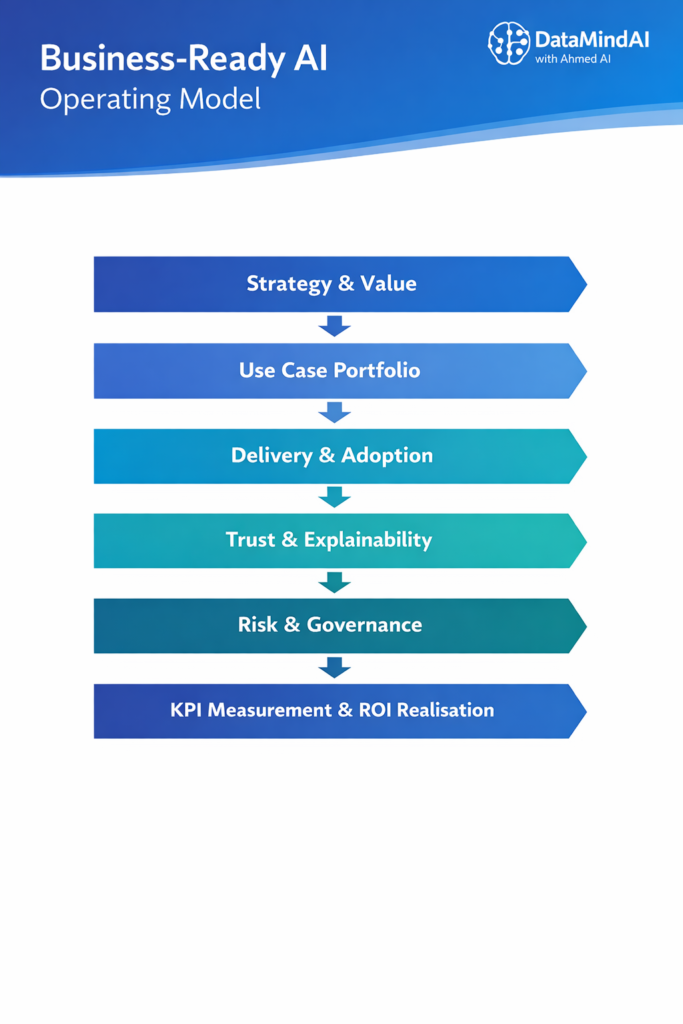
A simple operating model looks like this:
Strategy & Value
→ Use Case Portfolio
→ Delivery & Adoption
→ Trust & Explainability
→ Risk & Governance
→ KPI Measurement & ROI Realisation
Concept Overview: What “Business-Ready” Means
Business-Ready AI means you can answer — clearly and defensibly:
1) What value does this create? (ROI + KPIs)
2) Who owns it? (executive sponsor + business owner)
3) Why this use case now? (impact vs feasibility)
4) How will people adopt it? (change management)
5) Why should we trust it? (explainability + human-in-loop)
6) What are the risks? (privacy, fairness, security, compliance)
These map to the core pillars of Business-Ready AI:
– Clear Business Value
– Stakeholder Alignment
– Use Case Prioritisation
– Change Management
– Trust & Explainability
– Risk Management
How It Works: The Business-Ready AI Workflow
Step 1 — Define Value Before the Model
Start with a value hypothesis:
– What problem are we solving?
– What is the baseline today?
– What target improvement do we want?
– What is the timeline to value?
Example:
Manual invoice processing costs £500k/year.
AI extraction reduces effort by 60% and saves £300k/year.
Step 2 — Assign Real Ownership (Not “A Team”)
Every AI initiative needs:
– Executive Sponsor (funding + strategic alignment)
– Business Owner (requirements + adoption + outcomes)
– AI/Data Owner (delivery)
– Security/Compliance Owner (risk sign-off)
If ownership is unclear, scaling will fail.
Step 3 — Prioritise Use Cases with a Value Matrix
Use a simple Impact vs Feasibility matrix:
– Quick Wins (high impact, high feasibility) → do first
– Strategic Bets (high impact, low feasibility) → invest
– Learning Projects → build capability
– Avoid → stop wasting time
Step 4 — Design Adoption Into the Solution
Adoption is not “training at the end.”
It includes:
– embedding into existing workflows (CRM, Service Desk, Finance tools)
– role-based training
– feedback loops
– success metrics (usage, trust, overrides, outcomes)
Step 5 — Build Trust Through Explainability
If stakeholders don’t trust AI, they won’t use it.
Trust mechanisms include:
– model cards (what it does / doesn’t do)
– explainability (feature importance, local explanations)
– “what-if” scenarios
– human-in-the-loop decisions for sensitive cases
Step 6 — Make Risk a First-Class Citizen
Business-ready AI includes governance from day one:
– privacy and data controls
– bias and fairness checks
– security threat modelling
– incident response plans
– accountability for harm
Code Example (Simple KPI + ROI Tracking Template)
baseline_cost = 500000
post_ai_cost = 200000
implementation_cost = 120000

annual_savings = baseline_cost - post_ai_cost
roi = (annual_savings - implementation_cost) / implementation_cost

print("Annual savings:", annual_savings)
print("ROI:", round(roi * 100, 1), "%")
Why this matters:
Executives don’t fund “accuracy.”
They fund measurable impact.
Comparison Table
| Feature | Tech-Ready AI | Business-Ready AI | Recommendation |
|---|---|---|---|
| Success metric | Model accuracy | ROI + adoption + outcomes | Measure value end-to-end |
| Ownership | Data team | Executive + business owner | Assign accountability |
| Prioritisation | What’s interesting | Impact vs feasibility | Build a use-case portfolio |
| Rollout | Deploy model | Adopt change | Design for workflow integration |
| Trust | “It works” | Explainability + HITL | Treat trust as a requirement |
| Risk | Consider later | Built-in governance | Shift-left risk controls |
❌ Pitfalls / Anti-Patterns
Anti-pattern 1: “Let’s build it and find value later.”
This creates expensive prototypes with no traction.
Anti-pattern 2: “The AI team owns the outcome.”
If the business doesn’t own it, adoption dies.
Anti-pattern 3: “We’ll handle governance after go-live.”
This is how projects get blocked by compliance and security.
✅ Best Practices
Define ROI and KPIs before building anything
Assign an executive sponsor and business owner per use case
Use a value matrix to prioritise
Treat adoption as a product launch (not an IT release)
Build trust (explainability + human-in-loop)
Implement Responsible AI controls early
📌 Key Takeaways
AI doesn’t fail because models are weak — it fails because the business system isn’t ready
Business-Ready AI turns AI into an operating model, not a science project
If you can’t measure value, assign ownership, and drive adoption — scaling will break